Bitcoin questions deserve an informed answer.
Your clients are already reading about Bitcoin. When they ask, a vague answer could cost you your credibility. This FAAA-accredited course gives you the grounding to explain what Bitcoin is, examine the research behind it and handle the conversation with confidence, within your authorisations.
Enquiring for a practice or licensee?
FAAA-accredited · 5.0 CPD hours · Foundation · Accreditation no. 36157

As the landscape changes, don’t get complacent.
Bitcoin is no longer a fringe question.
Some of the world’s largest asset managers now publish in-depth research on it and offer funds that hold it. Resorting to calling it a “scam” or “ponzi” would get you laughed out of those same institutional boardrooms.
Your obligations don’t change because the subject is new: acting in a client’s best interests means understanding what they ask about, knowing what the evidence shows, and being able to explain how you reached your view.
What does the research show, over which period, and under what assumptions?
What could go wrong in markets, custody, liquidity and implementation?
What are you authorised to discuss, and what does your licensee require?
Understanding Bitcoin doesn’t oblige you to recommend it. It does mean you can answer the question.
Be the adviser with the answer.
A defensible file.
A clear, evidence-based record of how you approached the question serves the client and supports you, whatever you conclude.
A steadier client relationship.
Clients read about Bitcoin whether or not they raise it. An adviser who can explain it plainly, including its risks, is better placed than one meeting the question for the first time.
A shared language across the practice.
When every adviser starts from the same grounding, file notes and client conversations are more consistent, and your compliance team has one reference point.
Read the research to update your perspective.
Some of the world’s largest asset managers have studied what Bitcoin does in a portfolio. Here is what three of them found, and the assumptions behind each.
Fidelity Digital Assets
Argues that institutional investors should hold a well-informed rationale for their Bitcoin position, including when that position is zero: in its words, the decision should be “the result of a well-informed process”. It assesses small allocations in a US 60/40 portfolio over 10-year and 5-year periods, to see how they would have changed returns, volatility and drawdowns. Read it for the reasoning, and check the period and assumptions.
Chris Kuiper, “Getting Off Zero: Evaluating Bitcoin in 2026”, Fidelity Digital Assets Research, 25 March 2026.
BlackRock
A conditional discussion of portfolio risk. It treats a small position as reasonable only for investors who expect broader adoption and can bear sharp falls, and it notes Bitcoin’s history of very large peak-to-trough declines. It is not a general allocation rule.
Henderson, Mitchnick, Cohen and Paul, “Sizing bitcoin in portfolios”, BlackRock Investment Institute, 11 December 2024.
VanEck
Sets out a four-part case: a fixed supply, growing adoption (US spot Bitcoin funds held about 1.27 million bitcoin in February 2026), a possible long-term inflation hedge, and diversification. It tests 0.5, 1 and 3 percent allocations in a US 60/40 portfolio and finds small allocations historically lifted returns with a modest rise in volatility, while noting that results depend on entry point and holding period. VanEck discloses that it has exposure to Bitcoin.
Kyle DaCruz and Denis Zinoviev, “The Investment Case for Bitcoin”, VanEck, data to 13 February 2026.
Summaries by BlockWise. Referenced organisations are research sources, not partners or endorsers of BlockWise. Sources last checked 2 October 2026.
What Fidelity found when Bitcoin was added to a 60/40 portfolio.
Fidelity Digital Assets tested small Bitcoin allocations in a US 60/40 portfolio, rebalanced once a year, over 10-year and 5-year periods. Choose a period and an allocation to see what its published figures show.
Fidelity’s published figures. A historical illustration, not a forecast or a recommendation.
Annual return and maximum drawdown, 10-year period
Past performance is not a reliable indicator of future performance. These are US funds in US dollars, before fees and tax, over two specific periods. Nothing here suggests how much of any client’s portfolio, if any, should be in Bitcoin. Module 5 examines how research like this is built and where it falls short. See what the course covers
Show Fidelity’s full tables, including Sortino ratios
| Allocation to Bitcoin | Annual return | Annual volatility | Sharpe ratio | Sortino ratio | Maximum drawdown |
|---|---|---|---|---|---|
| 0% | 9.44% | 10.26% | 0.72 | 1.09 | −20.64% |
| 1% | 11.25% | 10.65% | 0.85 | 1.34 | −21.02% |
| 3% | 14.56% | 12.04% | 1.01 | 1.76 | −21.79% |
| 5% | 17.55% | 13.80% | 1.09 | 2.09 | −23.21% |
| 7% | 20.30% | 15.65% | 1.12 | 2.34 | −24.64% |
| 10% | 24.09% | 18.41% | 1.15 | 2.62 | −26.72% |
| Allocation to Bitcoin | Annual return | Annual volatility | Sharpe ratio | Sortino ratio | Maximum drawdown |
|---|---|---|---|---|---|
| 0% | 7.86% | 11.06% | 0.46 | 0.66 | −20.64% |
| 1% | 8.24% | 11.28% | 0.48 | 0.71 | −21.02% |
| 3% | 9.00% | 11.85% | 0.52 | 0.79 | −21.79% |
| 5% | 9.74% | 12.54% | 0.56 | 0.86 | −23.21% |
| 7% | 10.47% | 13.34% | 0.58 | 0.91 | −24.64% |
| 10% | 11.52% | 14.68% | 0.60 | 0.98 | −26.72% |
Source: Fidelity Digital Assets Research via PortfolioVisualizer.com, 1 January 2016 to 31 December 2025. Stocks: iShares Core S&P Total U.S. Stock Market ETF (ITOT). Bonds: iShares Core U.S. Aggregate Bond Index ETF (AGG). Bitcoin: spot market price. Rebalanced annually to target allocations, dividends reinvested; the Bitcoin allocation is funded equally from stocks and bonds. Chris Kuiper, “Getting Off Zero: Evaluating Bitcoin in 2026”, Fidelity Digital Assets, 25 March 2026. Funds are named only to describe the study; this is not a recommendation of any product.
Seven common criticisms. Examined, not dismissed.
Your clients will raise these, and several carry genuine substance. Module 4 sets out each criticism fairly, then tests it against the evidence, so you can discuss it accurately rather than wave it away.
- 01
“It has no intrinsic value.”
How assets without cash flows, such as gold, are valued, and one published attempt to value Bitcoin.
- 02
“It’s too volatile to be money.”
How Bitcoin’s volatility has changed over time, and what drives it, including leveraged futures trading.
- 03
“It wastes energy.”
What kind of energy Bitcoin mining uses, when and where, and the limits of the data behind the headline figures.
- 04
“Governments will just ban it.”
What happened when China banned Bitcoin in 2021, and how access has changed in other countries since.
- 05
“There are thousands of cryptocurrencies. Why Bitcoin?”
How Bitcoin differs from the wider crypto market in governance, track record and network effects.
- 06
“Quantum computing will break it.”
What the risk actually is, which coins are most exposed, and the proposals to address it.
- 07
“It’s too slow to compete with Visa.”
How Bitcoin’s base layer compares with payment and settlement systems such as Visa and Fedwire.
- And
The risks the course names.
Volatility and past falls of more than 70%, custody and lost keys, regulatory change, behaviour under stress, a short track record, tax, and how each product works.
Build the knowledge. Then the conversation.
Six recorded modules move from monetary foundations to Bitcoin, then apply that context to research, risk and your role. No prior Bitcoin knowledge is assumed.
The history of money
Understand what money is, what traits people look for in money, why we landed on gold, and what happens when money becomes centrally controlled.
How today’s monetary system works
Learn how money is created in a fiat economy: fractional reserve banking, the Keynesian and Austrian schools of economics, the debt-based system, financial repression, and case studies for evidence.
The consequences of today’s money
Examine how a money’s hardness affects time preference, what the Cantillon effect is, and six observable consequences of a fiat monetary standard that your clients can feel.
What is Bitcoin?
Delve into Bitcoin’s monetary properties, a high-level technical overview, why it was created, a comparison of gold, fiat and Bitcoin as money, how Bitcoin affects time preference and the Cantillon effect, and seven common criticisms of Bitcoin with the evidence on each side.
Institutional research and portfolio implications
Review how a small Bitcoin position affects portfolio performance in research from some of the largest US financial firms, understand the limitations of that research, and see which players in the Australian investment landscape are discussing Bitcoin.
The adviser’s role
Understand how to meet your best interests duty, ASIC’s guidance on the asset, the investment and custody options for Bitcoin exposure, and what belongs in Statement of Advice documentation.
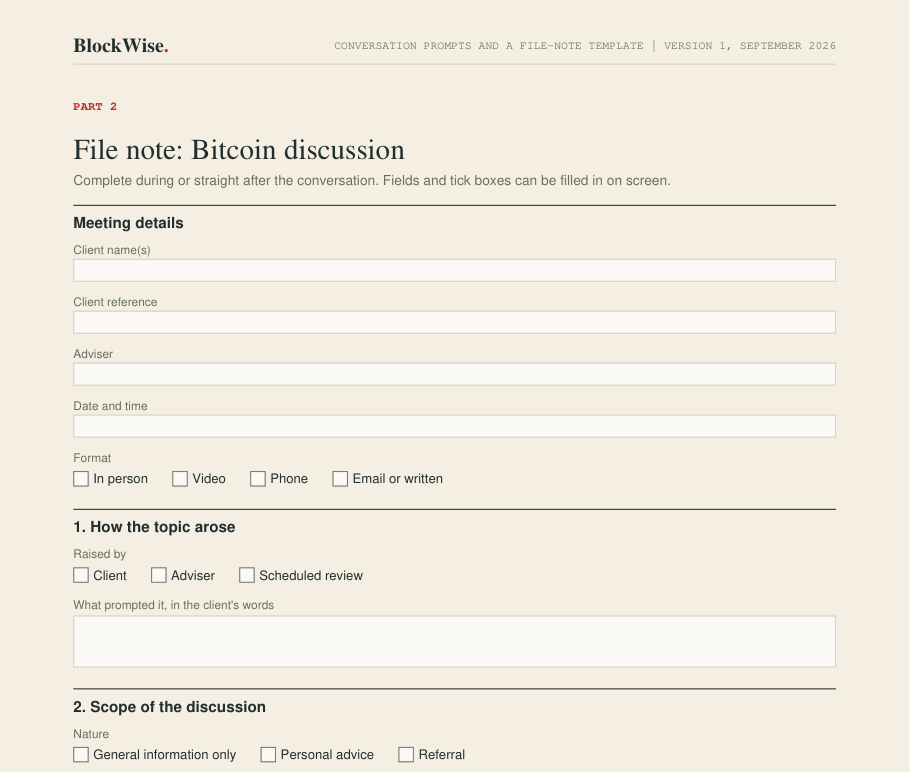
Then a 15-question multiple-choice assessment, with a pass mark of 75 percent and up to three attempts, and a certificate for your CPD record. Module 6 also gives you client-conversation prompts and a file-note template, so you can record how you approached the question.
A file-note template, ready to adapt to your licensee.
A fillable PDF and Word template that follows the conversation from how the topic arose to the outcome: the scope of the discussion, the client’s objectives and risk profile, existing exposure and custody, the risks discussed, the alternatives considered, the client’s understanding, and next steps.
It records a “no change” outcome with the same care as any other.
Who teaches it.
You should know who is teaching you, and what they stand to gain, before you weigh anything they say.

Michael Paige
Co-founder and presenter
About ten years in Australian equity markets: as an associate adviser, as an equity analyst and, most recently, leading the Content team at Simply Wall St, including its weekly Market Insights newsletter.
He brings an equity-research habit to the course: set out the evidence, show the working, and write the reasoning down, whatever the conclusion.
What we stand to gain.
- The course fee, and nothing else. No commissions, referral fees or affiliate payments from any exchange, fund manager or platform.
- Nothing to sell you afterwards. We issue no financial product, recommend no allocation and name no product to buy.
- Our own position. Michael and Tom hold Bitcoin personally. Weigh our view with that in mind.
One foundation for the whole practice.
Advisers in the same practice hear the same client questions. Enrolling together gives everyone the same grounding, the same language for those conversations and a common reference for file notes. For licensees, the course is independent education: BlockWise issues no financial product, recommends no allocation and names no product to buy.
Group enrolment.
Tell us how many advisers you would like to enrol and we will arrange it.
The accreditation facts for your compliance team.
Accreditation number, rating and the CPD category split, ready for your CPD policy check.
Completion records.
Tell us what your CPD register needs and we will work out how to provide it.
Make a practice or licensee enquiry
Practice and licensee pricing on enquiry. Acceptance of CPD hours remains subject to your licensee’s CPD policy.
The details that matter.
FAAA accreditation 36157 · Foundation learning rating · Approved 25 August 2026 to 25 August 2027. Acceptance remains subject to your licensee’s CPD policy.
| Category | Hours |
|---|---|
| Technical competence | 2.0 |
| Regulatory compliance and consumer protection | 0.5 |
| General | 2.5 |
| Total awarded CPD | 5.0 |
This activity meets the guidelines for qualifying CPD, and has been accredited for continuing professional development by the Financial Advice Association Australia but does not constitute FAAA's endorsement of the activity. Accreditation number 36157 for 5.0 hour(s).
Accreditation relates to the course as a CPD activity. It is not a recommendation to invest in Bitcoin or any product.
The practical questions. Before you begin.
I don’t know enough about Bitcoin to discuss it. Where do I start?
That is the most common starting point, and the easiest to fix. The course assumes no prior knowledge. It starts with money itself, then builds to Bitcoin, the research and your role.
Isn’t Bitcoin too volatile to discuss with my clients?
Volatility is a real risk and the course treats it as one. You will learn how to read drawdowns, position sizing and portfolio research, and how to explain those risks plainly. The course does not tell you what any client should hold.
My clients haven’t asked about it.
Many will still read about it. Being able to explain what Bitcoin is, what the risks are and how you reached your view means you are not meeting the question for the first time when it comes.
Our approved product list excludes crypto. Is the course still relevant?
Yes. The course is built for practices whose list includes these products and for those whose list does not. It does not expand your authorisations, change your approved product list or permit advice outside your licensee’s policy.
Is the regulatory position settled?
It is changing. ASIC updated its guidance on digital assets in October 2025, and the Digital Assets Framework Act 2026 commences in April 2027. The course covers regulation and professional boundaries in module 6. Nothing in it changes your licensee’s obligations or your own.
Aren’t cryptocurrencies mostly scams?
Some are, and the course does not ask you to take Bitcoin on trust. Module 4 examines how Bitcoin works, how it differs from the wider crypto market, and seven common criticisms with the evidence on each side. Module 6 covers custody and regulation.
Does the course tell me to recommend Bitcoin?
No. The aim is understanding. Learning about an asset is distinct from deciding whether it suits a client. A reasoned conclusion may be no allocation. Your professional obligations and your licensee’s policies continue to apply.
How much time does it take, and what CPD do I get?
The course carries 5.0 FAAA-accredited CPD hours: 2.0 technical competence, 0.5 regulatory compliance and consumer protection, and 2.5 general. It is self-paced, with 12 months’ access from enrolment.
How do the assessment and certificate work?
After the six modules you sit a 15-question multiple-choice assessment. The pass mark is 75 percent, with up to three attempts. When you pass, you receive a certificate for your CPD record.
Can our practice enrol together?
Yes. Tell us how many advisers and what records you need, and we will come back to you. Make a practice or licensee enquiry
What if the course isn’t right for me?
You can ask for a refund within 7 days of purchase, provided you have spent less than one hour on the course material and have not claimed a certificate. Email hello@blockwise.au from the address you enrolled with. This does not affect your rights under the Australian Consumer Law.
Answer the Bitcoin question with confidence.
Build the knowledge to explain the risks and evaluate the evidence your clients may encounter, at a pace that fits around your practice.
- 5.0 FAAA-accredited CPD hours · accreditation no. 36157 · Foundation learning rating
- Six self-paced video modules, a multiple-choice assessment and a completion certificate
- A$495, Australian dollars, one payment · 12 months’ access from enrolment
Refunds. Refunds within 7 days of purchase, provided you have spent less than one hour on the course material and have not claimed a certificate. This does not affect your rights under the Australian Consumer Law. Full refund and access terms
Already enrolled? Continue learning
Important information
General information only. The content on this site is general information and education. It is not financial advice, investment advice, tax advice or legal advice, and it does not take into account your or your clients’ specific objectives, financial situation or needs. No allocation to any asset is recommended.
Past performance. Past performance is not a reliable indicator of future performance. Bitcoin is a volatile asset and has historically experienced drawdowns in excess of 70%. Any decision for a client should be made in line with the best interests duty, that client’s objectives, financial situation and needs, and your licensee’s policies.
Regulatory. BlockWise is an education firm. We do not hold an Australian Financial Services Licence (AFSL). We do not provide personal financial advice, custody client funds, or execute transactions on behalf of clients.
Third-party names. Fidelity®, BlackRock® and iShares® are trademarks of their respective owners. BlockWise is independent and not affiliated with, endorsed by, or sponsored by any organisation referenced on this page.
Who you are buying from. Michael Robert Paige, trading as BlockWise, ABN 25 258 356 452.